The wee Sugar Sheds inspired ghost story "Candy Bones" has been shortlised in The Woman In Black Ghost Story competition. If you haven't already, why not pop over to youtube and give it a watch.
It's a very short story, will only take up two minutes of your time, and if you like it, please give it a wee thumbs up on youtube. The prize if it wins is not fortune, but glory, as it would appear on "The Woman In Black" dvd as an extra...how's that for giving the Sugar Sheds a new audience. Well, a new audience of people that watch DVD extras...Sadly however, if successful, for reasons of international understanding, my voice would be replaced and the story read by someone called "Daniel Radcliffe".
And if that story isn't really for you...then don't worry...there's 9 others on there to choose from.
Check out The Woman In Black's youtube channel.
Sweet.
Friday, 30 December 2011

Friday, 16 December 2011
Candy Canes and Gingerbread Sheds

This week in Sugar Sheds related news...there's a further lifeline for Riverside Inverclyde; the piece here definetly suggests that some of that involves seeking lottery funding for future projects..something we have suggested around the Sugar Sheds from the very start.
Successful lottery funding requires significant and genuine local consultation, involvement and even partnership. There's a way yet to make this all start working for everyone, and lots of options to explore; there's Big Lottery's Growing Community Assets Fund; there's SCVO and Unity Trust Bank's 50million loan scheme for third sector / social enterprise business centres; and of course it's been a while since Inverclyde secured any major capital funding through Heritage Lottery Fund Scotland. Not to mention new funding available for events through Creative Scotland 2012 Year of Creativity. And those are just the top of the google search. All this of course is set against the publication of Scottish Governments new Regeneration Strategy, firmly placing local people at the heart of regeneration . Everything to play for.
So. Six months on, as the year ends, thanks very much to everyone who has helped out, kept in contact and stuck with us; a successful campaign is more than a facebook click, but from the initial flurry around that page, we've been able to get discussions with the people who can influence this situation and meet many people who've successfully fought for change elsewhere. Next year what we're after is some action. Here.
For now, festive fun...
Two of the bands who helped out with our Celebration Ode recordings have recorded Christmas tunes. I'm a sucker for Christmas tunes.
Ard Amas have "It's Christmas" and some other new tunes on their myspace.
Sneaky Pete have a new tune dropping this weekend as well.
And local band The Purple Doves have released a charity single for Christmas with all proceeds going to Ryan Ferguson's Leukaemia Fund. Buy it now on itunes.
Over on our heritage blog Tales of the Oak, we're curating our Ghost Stories For Christmas throughout December.
And on my own blog Stramashed, you can find out all about Santa's Little Werewolves.
See you all next year.
Here's a few wee sugary Christmas tunes...
Sweet.
Monday, 12 December 2011
The Regeneration Game - New Rules

The Scottish Government have released their new regeneration strategy. Well worth a read.
An initial scan reveals a number of areas which could impact on any future regeneration projects based around the Sheds (and of course everywhere else!).
First and foremost, we have a handy definition for what is actually considered "regeneration".
Regeneration is the holistic process of reversing the economic, physical and social decline of places where market forces alone won’t suffice. This holistic theme runs throughout this Strategy and forms the basis for the propositions and conclusions.
Good start. Holistic is good. Provided everyone's signed up to being holistic of course.
A number of key themes were identified in the initial discussion papers which informed the report.
- Clarification on the roles and responsibilities that different organisations have in delivering regeneration
- Recognition that a coordinated approach is needed at a local level and across public services to tackle area-based disadvantage
- The importance of community led regeneration
- Recognition of the constraints on public sector finances alongside a continued need for appropriate grant support and innovative funding solutions
- The importance of placemaking in supporting successful communities
- Support for town centres as a central part of community life
Hmmm. Liking where the community appear to be placed in this regeneration process. Mind you, we have all heard similar things before. The strategy recognises some of the ingredients for regeneration which has been measurably successful;
Our future regeneration activity must focus on outcomes and take account of lessons learned. The key success factors for designing and delivering regeneration interventions, are detailed below. Public, private and third sector partners should consider these key elements when delivering regeneration locally.
- puts communities first, effectively involving local residents in the regeneration process and empowering communities
- is holistic, making connections between the physical, social and economic dimensions
- adopts a long-term vision for a places and focuses the on the safety and quality of places
- takes account of the specific function of neighbourhoods and integrates regeneration initiatives into wider economic strategies
- makes tailored interventions to link economic opportunity and need to address worklessness and deliver sustainable quality employment
- is supported by simple and aligned funding streams and maximises the impact from mainstream resource by better integration with place-based interventions
- Has strong leadership with clear accountability and makes effective use of partnership working, involving the private sector, both in investment and in shaping ideas and development.
The really interesting stuff for me is from page 20 "Community Led Regeneration. Local People Delivering Local Change", which outlines exactly how communities will be able to influence regeneration processes and what resource will be made available from Government to assist. Here's a few highlights, then seriously, go read the report.
Lots more to read, and as ever, the devil isn't so much in the detail as in the reality of local delivery, but certainly this would seem to give a clear nod as to where regeneration initiatives will be steered from next year. Interesting times.
Community led regeneration is about local people identifying for themselves the issues and opportunities in their areas, deciding what to do about them, and being responsible for delivering the economic, social and environmental action that will make a difference. It is dependent on the energy and commitment of local people themselves and has a wide range of benefits.
Community led regeneration covers a spectrum of activity from committed volunteers coming together informally to campaign or act, to the work of enterprising local community anchor organisations like Development Trusts and community based housing associations.
Building on the success of the Wider Role fund and recognising the important role that Registered Social Landlords (RSLs) and other community groups like Development Trusts play in delivering change at a local level, we have developed the People and Communities Fund. This fund forms part of the overarching Regeneration Investment Fund.
The Scottish Government will provide £7.9m per annum from 2012 to 2015 to support the People and Communities Fund, specifically to promote and support community led regeneration. The details of this fund will be announced in 2012, however, activity will include:
- Building on the Wider Role fund, funding to support and strengthen local community anchor organisations across Scotland, including RSLs and Development Trusts. These will be organisations that deliver local support for community asset ownership through the Community Ownership Support Service. This service, provided through the Development Trusts Association Scotland (DTAS), provides help and advice to community organisations interested in asset ownership.
- Investment in a new community capacity building programme. This will focus on areas where there are currently few local organisations, weak networks amongst local people and where local people's skills and confidence need to be nurtured. It will have a focus on helping people to decide how budgets in their areas are spent.
Lots more to read, and as ever, the devil isn't so much in the detail as in the reality of local delivery, but certainly this would seem to give a clear nod as to where regeneration initiatives will be steered from next year. Interesting times.
Friday, 2 December 2011
A Ghost Story for Christmas
I know its been a wee while since our last update, but there’s been a fairly major development in the ongoing Story of The Sugar Sheds.
If you follow our local press, you’ll maybe be aware that local regeneration company Riverside Inverclyde has had its funding dramatically reduced, making the outlook for them post 2012/13 very challenging indeed. At this early stage, there are obviously many questions still to be asked about all of this, and what projects RI are going to be able to focus on over the next 18 months. But clearly, whatever the outcome, developments and plans for the James Watt Dock / Sugar Sheds are likely to be affected.
So that’s that then eh? Let’s just leave it. Eh…nope. If anything, this kind of uncertainty over “what next” requires more attention. Next year, it’s our plan to keep the Sugar Sheds on the agenda, at the very least, we still think there’s some mileage in our outlined programme of events.
In the meantime, with the nights drawing in and the nip in the air, here’s a short Sugar Sheds inspired Ghost Story For Christmas, “Candy Bones”. There’s a whole month of this sort of festive malarkey over on our Tales of The Oak blog.
Wednesday, 2 November 2011
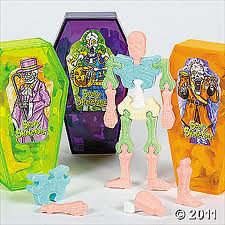
Candy Skeletons
Here's our piece from todays Greenock Telegraph...
The darker side of The Sugar Sheds history was explored last week when psychic medium Joan Charles took a tour around the iconic buildings with local heritage enthusiasts.
Joan has spent the last few months exploring mysterious and unusual locations across the UK
“The minute I walked in, I felt the atmosphere was very oppressive, just a real feeling of being trapped, not just physically, but maybe..financially. The people who worked in here had a very hard life inside and out of the Sheds. A lot of illness and disease.”
Construction on The Sugar Sheds began in 1885, with the buildings being completed 125 years ago in 1886. Thousands of people have worked in and passed through The Sheds since then, including German and Irish workers, something which Joan picked up on immediately.
“There was a real sense of multiculturalism there, not just in terms of the ships docking, but the people working, the people stuck inside. I was getting real Dutch and Canadian connections as well.”
Joan was in no doubt about one thing,
“People have died there. I was getting a man who had died in a fire there, trapped inside. Not the recent fire, before that.”
Paul Bristow is part of the Keep Greenock Sugar Sheds a Community Space campaign, and as a member of Magic Torch, has been researching and writing about local heritage and folklore for over ten years.
“With old buildings, there’s always a strange feeling, a sort of absence, spaces which were once so full of people and life, now empty and silent. The Sheds are a tremendously atmospheric space, and I was really interested to see what someone a bit more sensitively tuned to that space than myself might be able to find out! We’ve worked with Joan a few times before in exploring local spaces with a bit of dark history.”
Paul was really interested in some of the areas Joan was talking about which he had not heard before.
“Joan was particularly interested in the remains of the lift shaft in Shed A, a site which anecdotally has been the location for a number of deaths within The Sheds over the years. There were a few things which we’ll have to check up on, a number of specific family names and related events, other instances of fire within the building, and also the possibility that there were ever coffins stored within the sheds. It’s good to have a few new lines of enquiry.”
Following the success of The Tall Ships in Greenock earlier this summer, The Sugar Sheds have been the focus of a local campaign to see more events hosted there.
Two multinationals and a number of community groups are discussing potential future uses for The Sugar Sheds with the buildings owners, James Watt Dock LLP. The LLP are currently accepting expressions of interest from Events Management Organisations looking at developing commercial events in this unique location.
One of the more popular suggestions for events within the space was a Halloween event with music, horror films and ghost hunting based on Joan’s initial experiences, there’s certainly plenty there to find!
Just to keep you jangling...here's the theme tune from Clive Barker's horror film The Candyman...(the original short story was set in Liverpool, another "sugar town")
Saturday, 29 October 2011
Candy Apples

It was Greenock’s very own Abram Lyle who discovered Golden Syrup in 1883, back in the days when civic leaders and businessmen were also pioneering inventors, adventurers, philanthropists and general all rounders.
Golden Syrup is beloved by many, and at this time of year, is an absolutely critical ingredient in right good Candy Apples for Halloween. (It’s also very useful for making Gingerbread Sheds..but more of that nearer Christmas..)
Ingredients
30 apples
5 cups of white sugar
½ cup Golden Syrup
1 ½ cups water
2 tsp blackcurrant syrup
Place lollipop sticks or wooden craft sticks into each apple at the stem end. Set aside.
In a heavy saucepan, mix together the sugar, golden syrup and water. Bring to a boil, then reduce the heat to medium and continue to cook until the mixture reaches 300 to 310 degrees F (149 to 154 degrees C), or until a small amount of syrup dropped into cold water forms hard, brittle threads. This will take a good 45 minutes!
Remove the sugar mixture from the heat and stir in the black currant syrup. Quickly dip all of the apples, holding them by the stick. You can let them cool by inserting the other end of the stick into a thick sheet of foam board. If that is not available, set the coated apples onto waxed paper or aluminum foil. Make sure they don't touch each other.
Nomm. Nomm. Nomm.
If yer after a more traditional recipe, or don’t actually want to make 30 Candy Apples at one go…try here.
And don’t forget that before giving any visiting Galoshans Candy Apples, they must perform The Galoshans Play.
The Galoshans Play
Friday, 28 October 2011
"Heritage + Development = ?"
Yesterday we were fortunate enough to attend the Scottish Civic Trust's conference on heritage, regeneration and development, a great opportunity to hear from the people leading the field in placemaking and civic pride.
We heard social, cultural and crucially, economic arguments for use and redevelopment of older buildings; historic building restoration uses fewer resources and creates more employment than new builds. It was incredibly refreshing to hear architects and government agencies commenting very clearly on the measurable benefits of involving the community in development of projects and programmes, beyond the superficial and passive notions of simply commenting on plans which have already been drawn.
There is a renewed emphasis too on energy efficiency in historic building adapatation, with grants currently available for buildings like The Sugar Sheds to explore the feasibility of sustainable energy use as part of any redevelopment.
From the Chord Projects just over the water in Helensburgh, through to Govan's redevelopments and the Govan Folk University and on to Maryhill Burgh Halls Trust...none of these are projects and processes a million miles away..all of these wonderful places and ideas are within half an hours drive. Those communities, agencies and architects have worked collaboratively to realise their shared vision. Surely we're not talking such a massive cultural leap to make similar things happen down here. Though obviously, what was clear from all involved was the time effort and energy that has been invested by all partners in making these ideas a reality. Here are projects which have developed with imagination, vitality and risk, daring to push beyond the minimum expected standard, and creating something all the more special as a result. The question we should ask ourselves and our civic leaders is not "why not here?" but "when do we start?".
More than anything, we came away convinced that such regeneration and development is possible when all parties involved are able to sit down respectfully and work together to be greater than the sum of their parts. It can happen, it can be done. Even here. And wouldn't it be great, if in the future, Inverclyde's regeneration of The Sugar Sheds was able to be recognised as an example of innovation and best practice in the same way that these projects and programmes are now.
Next, we're off to visit Out of the Blue through in Edinburgh, a former Drill Hall, now the centre of a thriving cultural community...
If you are feeling like getting inspired by bold new building designs in old spaces, you can read a great new document from Historic Scotland and Archticture and Design Scotland, "New Design in Historic Settings" which was launched at the conference.
An inspiring day, thank you very much to the Scottish Civic Trust.
Subscribe to:
Posts (Atom)